
Notation. For symbol definitions, see the notation vignette.
Overview
multiple_treatment_group_analysis() estimates
child-penalty effects separately for each treatment group
(age at first birth). Because groups differ in their baseline earnings,
age composition, and selection, a single group’s estimate is not
directly comparable to another’s. aggregate_estimands()
collapses the group-specific estimates into a single number per event
time, answering the question: what is the average effect across the
distribution of first-birth ages?
Three aggregate estimands are available:
- avg_of_ratios (): weighted average of each group’s normalized effect . Formally, , where are population weights normalised to sum to one. Preferred because normalization happens within each group before aggregation, so baseline differences do not inflate the average.
- ratio_of_avgs (): ratio of the weighted-average ATE to the weighted-average APO. Formally, . This implicitly up-weights high-earning groups (their larger APO contributes proportionally more to the pooled denominator), so it differs from when earnings vary across groups.
-
gender_ineq
():
weighted average of
NTD_Newestimates — the aggregate gender-inequality penalty. Formally, .
Simulate and estimate
We simulate 2 000 individuals spanning treatment groups 24–30 (the extra groups serve as clean controls for the youngest treated cohorts), then analyse groups 24–27 with two post-treatment periods.
library(childpen)

data <- simulate_data(n_individuals = 2000, treatment_groups = 24:30)

res <- multiple_treatment_group_analysis(
  data             = data,
  treatment_groups = 24:27,
  periods_post     = 2,
  periods_pre      = NULL,
  verbose          = FALSE
)
Basic aggregation
Calling aggregate_estimands() with default arguments
applies sample-proportion weights (weights = "sample"),
where each treatment group is weighted by its share of the sample, as in
Leventer (2025). Standard errors account for the estimation of these
weights via the influence-function formula in the paper’s Appendix G.
Pass weights = NULL for uniform weights.
agg <- aggregate_estimands(res)
head(agg)
#>   event_time estimand     method      agg_type       est        se n_groups
#> 1          0    theta DID_Female avg_of_ratios -0.246280 0.0110061        4
#> 2          1    theta DID_Female avg_of_ratios -0.283778 0.0100062        4
#> 3          2    theta DID_Female avg_of_ratios -0.274356 0.0098125        4
#> 4          0    theta   DID_Male avg_of_ratios -0.049832 0.0150746        4
#> 5          1    theta   DID_Male avg_of_ratios -0.046805 0.0137026        4
#> 6          2    theta   DID_Male avg_of_ratios -0.052369 0.0128336        4
#>        ci_l      ci_h
#> 1 -0.267851 -0.224708
#> 2 -0.303390 -0.264166
#> 3 -0.293589 -0.255124
#> 4 -0.079378 -0.020285
#> 5 -0.073662 -0.019947
#> 6 -0.077523 -0.027215
The output has one row per
event_time × estimand × method × agg_type combination. The
n_groups column records how many treatment groups
contributed — useful for spotting cells where edge-of-sample groups drop
out due to max_age/min_age bounds.
Plot aggregate results
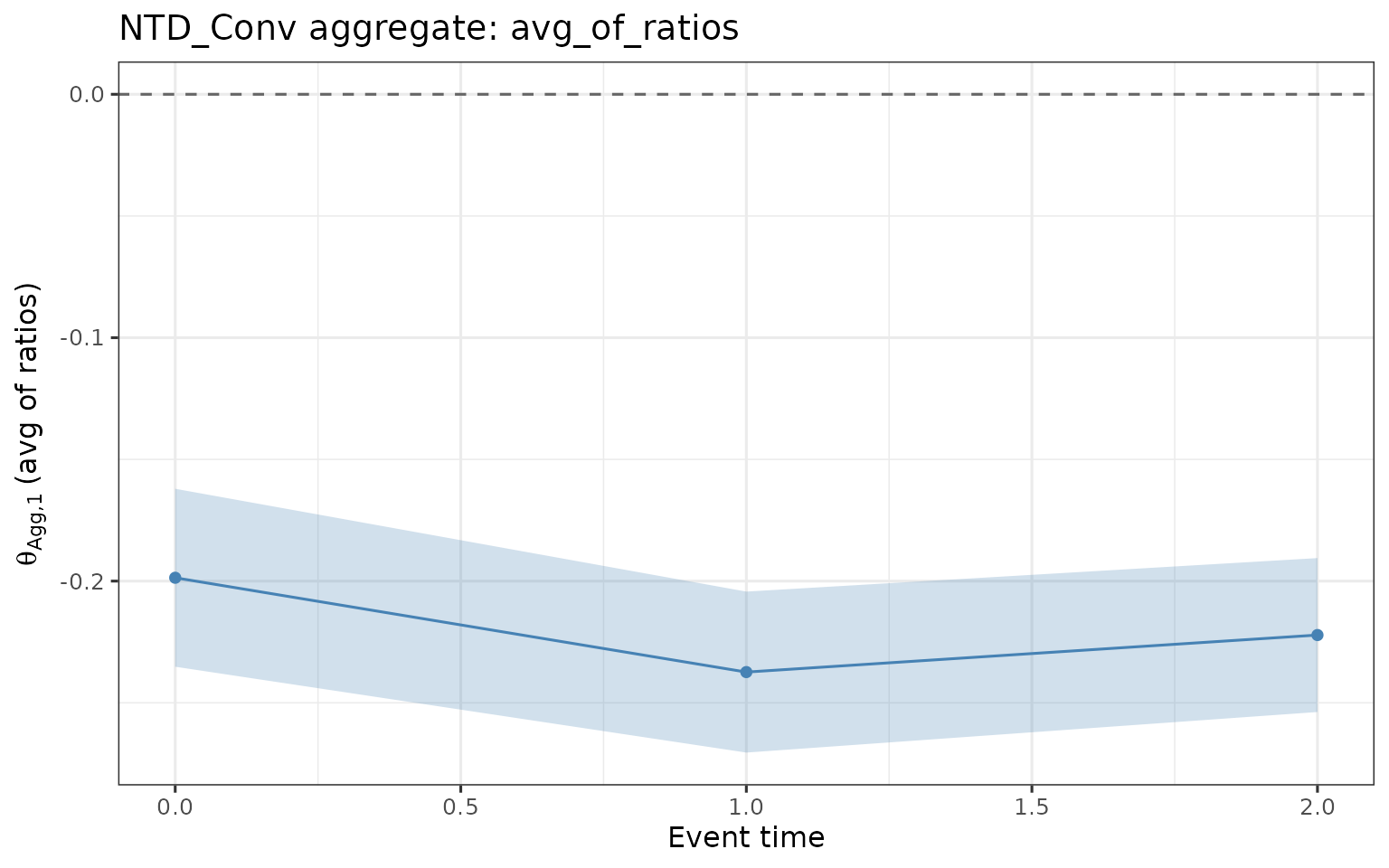
Plot the avg_of_ratios aggregate for the
NTD_Conv method across event times, with 95% confidence
ribbons.
agg |>
  filter(agg_type == "avg_of_ratios", method == "NTD_Conv", estimand == "theta") |>
  ggplot(aes(x = event_time, y = est, ymin = ci_l, ymax = ci_h)) +
  geom_ribbon(fill = "steelblue", alpha = 0.25, color = NA) +
  geom_line(color = "steelblue") +
  geom_point(color = "steelblue") +
  geom_hline(yintercept = 0, linetype = "dashed", color = "grey40") +
  labs(
    x     = "Event time",
    y     = expression(theta[Agg * "," * 1] ~ "(avg of ratios)"),
    title = "NTD_Conv aggregate: avg_of_ratios"
  )
Compare aggregation types
avg_of_ratios and ratio_of_avgs answer the
same underlying question but weight groups differently. When high
first-birth-age groups have higher counterfactual earnings than low
first-birth-age groups, ratio_of_avgs assigns them more
weight (the APO enters the denominator for each group before the ratio
is formed across groups). The two estimands therefore diverge whenever
earnings are heterogeneous across groups.
agg |>
  filter(
    agg_type %in% c("avg_of_ratios", "ratio_of_avgs"),
    method   == "DID_Female",
    estimand == "theta"
  ) |>
  ggplot(aes(
    x     = event_time,
    y     = est,
    ymin  = ci_l,
    ymax  = ci_h,
    color = agg_type,
    fill  = agg_type
  )) +
  geom_ribbon(alpha = 0.2, color = NA) +
  geom_line() +
  geom_point() +
  geom_hline(yintercept = 0, linetype = "dashed", color = "grey40") +
  labs(
    x     = "Event time",
    y     = expression(theta ~ "estimate"),
    title = "DID_Female: avg_of_ratios vs ratio_of_avgs",
    color = "Aggregation type",
    fill  = "Aggregation type"
  ) +
  theme(legend.position = "bottom")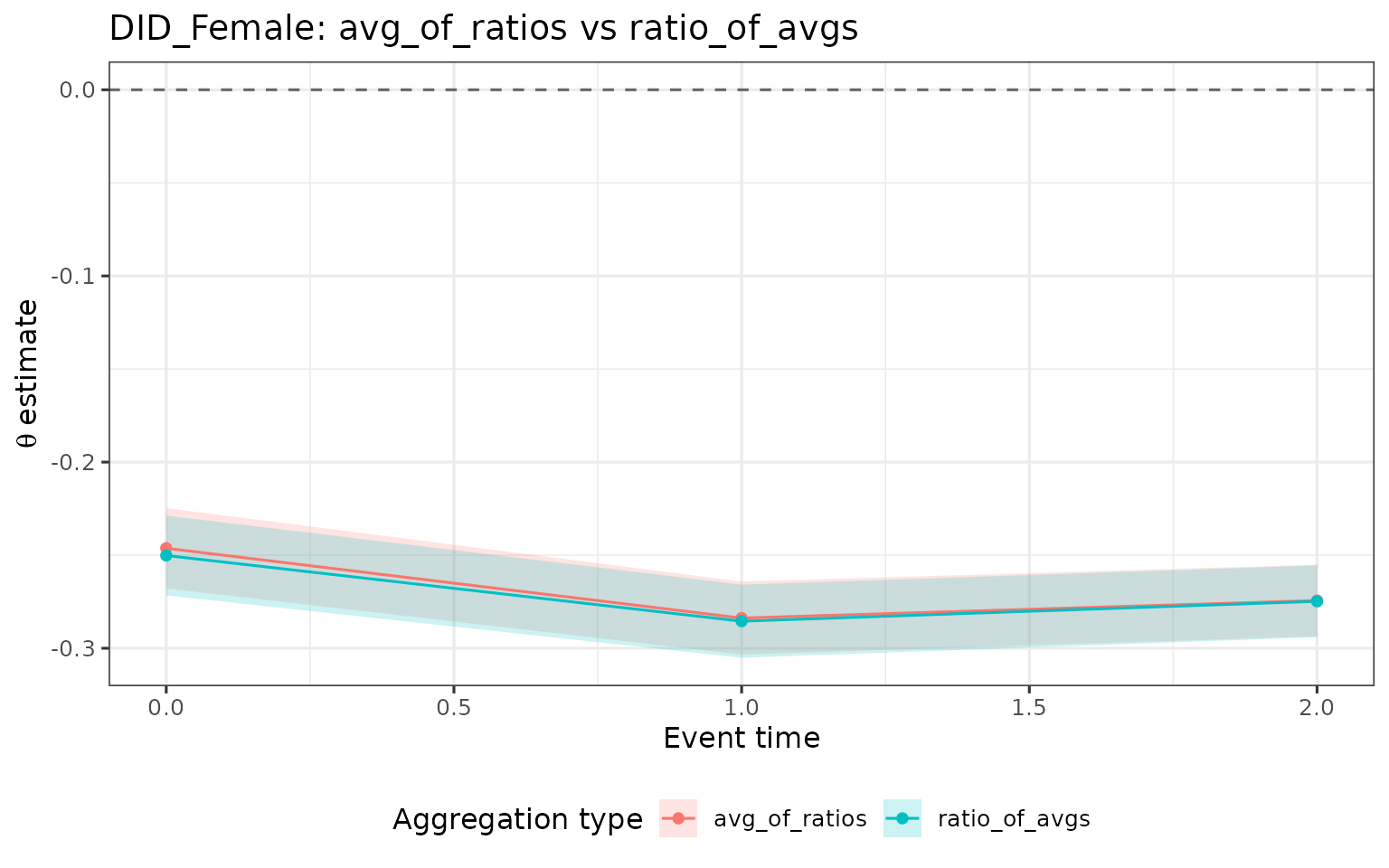
If the two lines are similar, earnings are approximately homogeneous across groups. Divergence is a sign that the treatment-group distribution interacts with baseline earnings levels, and the researcher must decide which weighting regime is more policy-relevant.
Custom weights
By default treatment groups are weighted by their sample proportions. Researchers may instead want to weight groups by their empirical share in a target population. Below we contrast two stylized distributions:
- Right-skewed (mimicking the US): most first births concentrate at younger ages.
- Left-skewed (mimicking Southern Europe): most first births concentrate at older ages.
groups <- as.character(24:27)

# Right-skewed: more weight on younger groups
w_us <- setNames(c(0.40, 0.30, 0.20, 0.10), groups)

# Left-skewed: more weight on older groups
w_se <- setNames(c(0.10, 0.20, 0.30, 0.40), groups)

agg_us <- aggregate_estimands(res, weights = w_us)
agg_se <- aggregate_estimands(res, weights = w_se)

bind_rows(
  mutate(agg_us, population = "US (right-skewed)"),
  mutate(agg_se, population = "Southern Europe (left-skewed)")
) |>
  filter(
    agg_type == "avg_of_ratios",
    method   == "NTD_Conv",
    estimand == "theta"
  ) |>
  ggplot(aes(
    x     = event_time,
    y     = est,
    ymin  = ci_l,
    ymax  = ci_h,
    color = population,
    fill  = population
  )) +
  geom_ribbon(alpha = 0.2, color = NA) +
  geom_line() +
  geom_point() +
  geom_hline(yintercept = 0, linetype = "dashed", color = "grey40") +
  labs(
    x     = "Event time",
    y     = expression(theta[Agg * "," * 1]),
    title = "Aggregate NTD_Conv estimate under different first-birth distributions",
    color = "Population weights",
    fill  = "Population weights"
  ) +
  theme(legend.position = "bottom")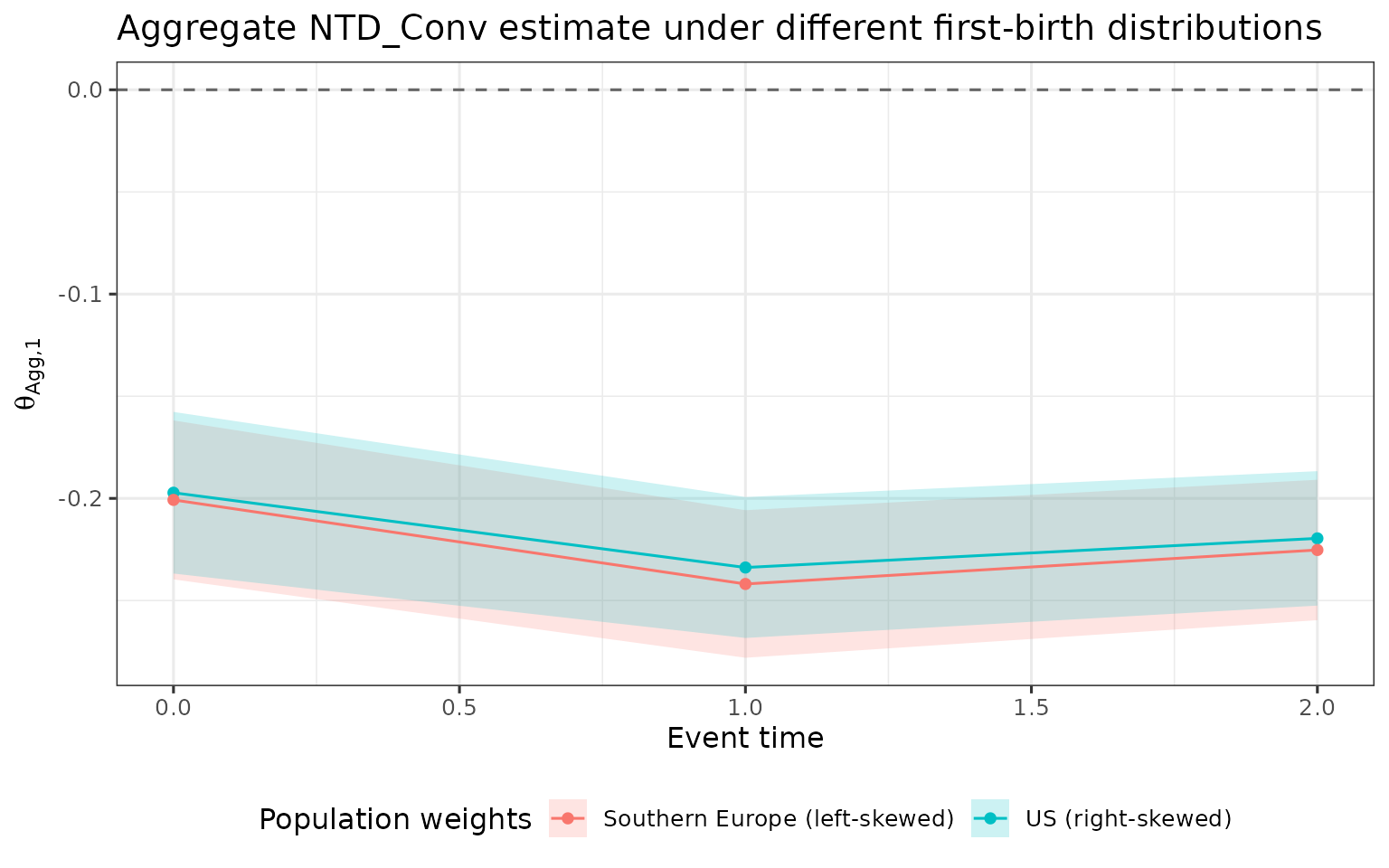
When younger groups bear larger penalties than older groups (or vice versa), the choice of weight vector shifts the aggregate estimate. Reporting both provides a sensitivity check on how much the aggregate depends on the first-birth distribution.
Gender inequality aggregate
The gender_ineq aggregate
()
is the weighted average of NTD_New
estimates across treatment groups. It measures how parenthood affects
the female-to-male earnings ratio: negative values indicate that mothers
bear a larger proportional penalty — the female-to-male earnings ratio
is lower post-birth than the counterfactual ratio.
agg |>
  filter(agg_type == "gender_ineq", estimand == "Delta_rho", method == "NTD_New") |>
  ggplot(aes(x = event_time, y = est, ymin = ci_l, ymax = ci_h)) +
  geom_ribbon(fill = "tomato", alpha = 0.25, color = NA) +
  geom_line(color = "tomato") +
  geom_point(color = "tomato") +
  geom_hline(yintercept = 0, linetype = "dashed", color = "grey40") +
  labs(
    x     = "Event time",
    y     = expression(Delta * rho[Agg]),
    title = "Gender inequality aggregate (NTD_New, avg of ratios)"
  )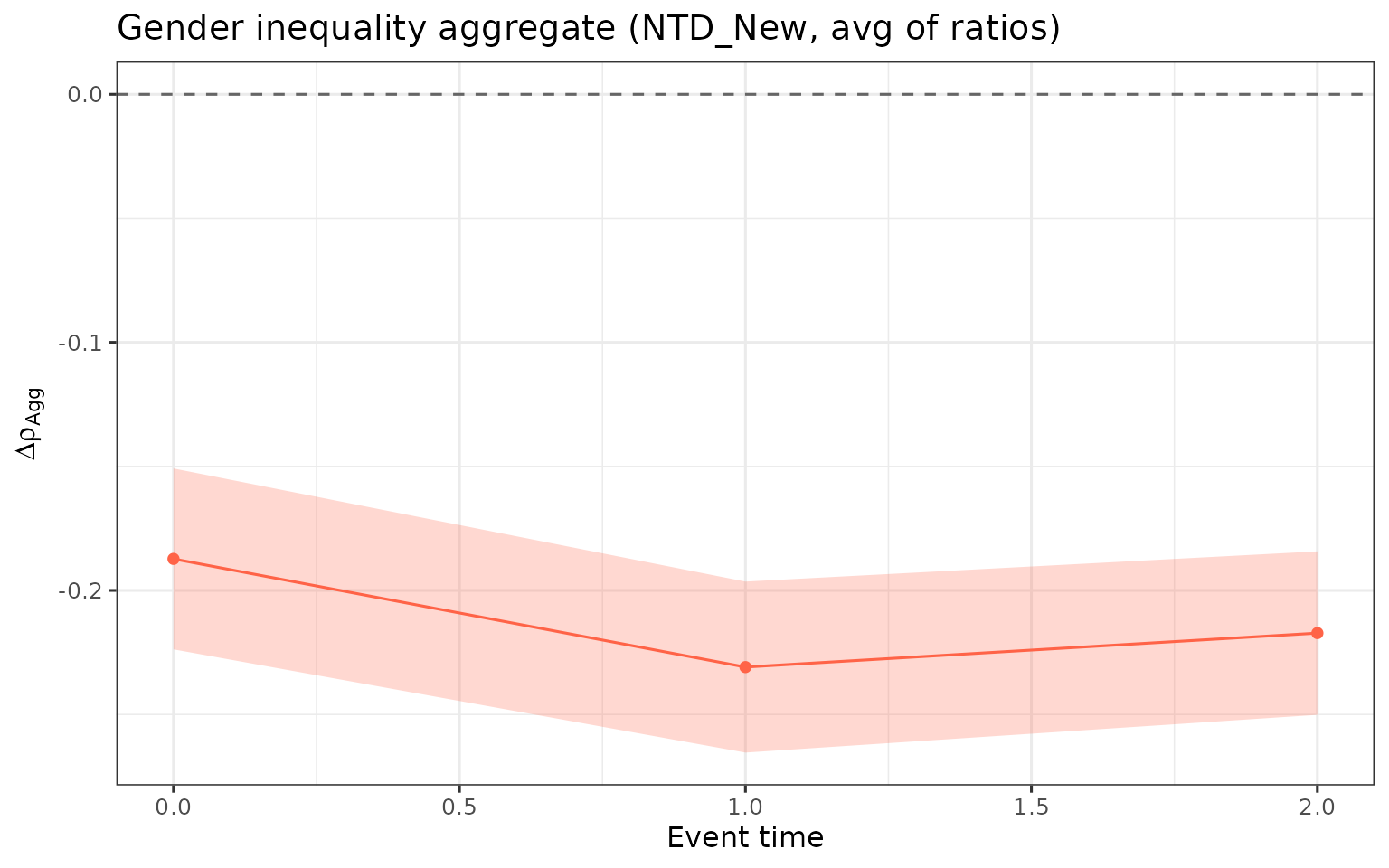
A flat, negative profile indicates a persistent parenthood-driven gender gap; values closer to zero at later event times suggest the gap narrows as parents age away from the birth event.